
©️2026 LimitlessStimulus.com
•••
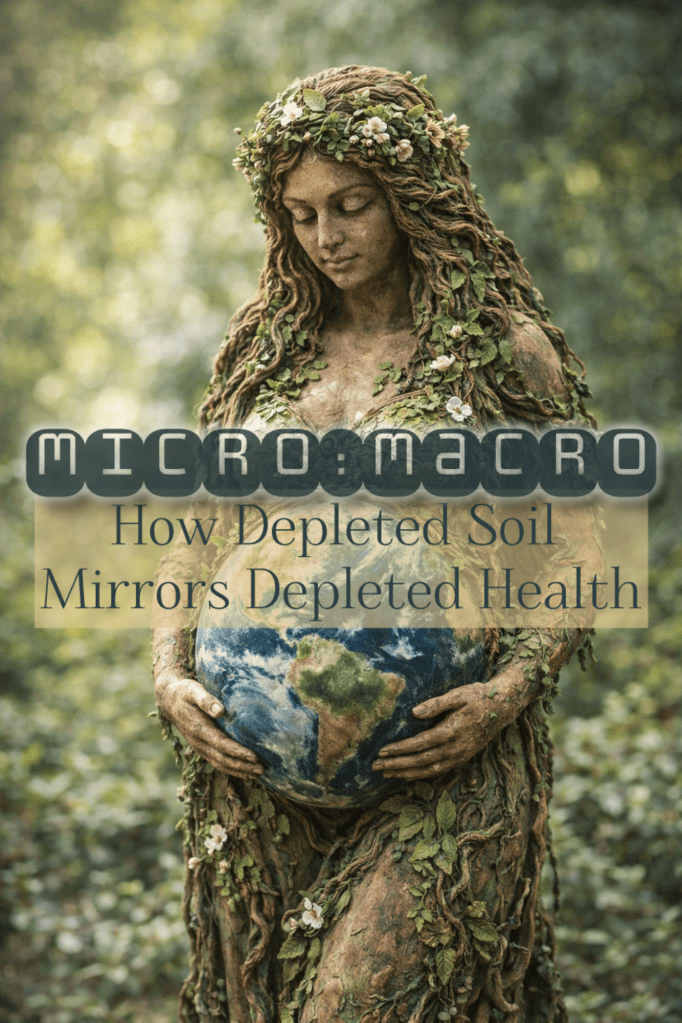
Micro : Macro
When We Stopped Caring for the Soil, We Taught People to Stop Caring for Their Bodies
•••
There was a time when soil mattered.
Not in a romanticized, back-to-the-land way.
But as something alive.
Something you tended carefully, because your survival depended on it.
And somewhere along the way, we stopped caring.
We traded patience for speed. Stewardship for efficiency.
Care for profit.
We asked the soil to produce endlessly without rest, stripped it of nutrients, fed it chemicals instead of nourishment, and told ourselves this was progress.
And it worked.
For a while.
Just like people.
Same damn thing.
We began producing endlessly without minimal rest, stripped ourselves of nutrients for the sake of convenience, fed our bodies chemicals instead of nourishment, and told ourselves this was normal.
Micro:Macro.
Here’s the part that keeps circling in my mind:
When we stopped caring for the soil, we taught people to stop caring for their own bodies.
Microcosm reflecting the macrocosm.
Macrocosm reflecting the microcosm.
Always.
We don’t talk enough about how deeply our food system – not just the current trendy hot topics but down to the very soil – mirrors our health crisis.
We eat more than ever, yet remain undernourished.
Calories are abundant, but vitality is scarce.
Everyone is tired.
Sad.
Defeated.
Deflated.
Always hungry, yet never fully alive.
Food looks nourishing, tastes engineered to keep us coming back, and somehow never quite satisfies.
Hunger lingers.
Cravings persist.
Bodies feel broken.
So we blame ourselves.
We talk about willpower.
Discipline.
Personal responsibility.
As if this were a moral failure instead of a systems failure.
• Depleted soil produces depleted food.
• Depleted food produces depleted people.
And then we shame the people for being depleted.
Soil is a living system.
So are bodies.
Both need minerals.
Both need rest.
Both need diversity, cycles, and care.
And both break down when treated like machines designed for constant output.
We normalized extraction at every level — from the land, from our bodies, from our time, from our children — and then acted surprised when everything started malfunctioning.
This isn’t a mystery.
It’s a consequence.
What we lost wasn’t just nutrients.
We lost relationship.
We stopped relating to soil as something alive.
And in doing so, we stopped relating to our bodies that way too.
We optimized them.
Managed them.
Pushed them.
And when they protest, we label them broken instead of listening.
Healing doesn’t come from force or optimization.
It comes from tending.
And tending is s l o w .
We’ve lost our patience for slow.
That’s reflected in just about everything we do and everything we consume present day.
Slow doesn’t fit neatly into profit-driven systems.
Here’s the good news, though — the part that actually matters.
Care is contagious.
When you reintroduce care into one small system, it ripples outward.
And you don’t need chemicals, expensive treatments, or expert credentials to do it.
You just need to begin paying attention again.
Starting with the soil around you.
If you have a garden, a yard, or even a small patch of earth, you can begin restoring what’s been lost — gently, imperfectly, and effectively.
Healthy soil doesn’t come from feeding plants.
It comes from feeding the soil itself.
• Compost matters more than fertilizer.
• Organic matter matters more than control.
• Fallen leaves, vegetable scraps, grass clippings — these aren’t messes: They’re nutrients returning home.
You don’t need a fancy compost bin. You can bury food scraps directly into garden beds or corners of the yard.
The soil knows what to do with them.
Microbes, fungi, worms — the quiet workforce we forget about — will handle it.
And lawns? Lawns don’t need to be sterile carpets void of biodiversity.
Clover, dandelions, and so-called “weeds” are often doing essential work, pulling minerals up from deeper layers and rebuilding what’s been lost.
Diversity isn’t a problem: it’s how systems stay resilient.
Bare soil is stressed soil.
Mulch matters. Leaves, straw, wood chips — whatever you have — help retain moisture, feed life, and protect what’s underneath.
Covered soil is calm soil.
Even watering teaches us something. Deep, gentle watering less often builds resilience.
Shallow, constant watering creates dependence.
Bodies respond the same way.
Micro:Macro.
Always.
And sometimes, the most restorative act is simply leaving things unfinished.
• Not clearing every stem in fall.
• Not sanitizing every surface in spring.
Life needs leftovers.
So do we.
What happens when you start tending the earth this way is subtle — and profound.
You relearn patience.
You relearn trust.
You relearn that healing happens in cycles, not straight lines.
And slowly, almost without noticing, that mindset turns inward.
You stop asking how to control your body and start asking how to care for it.
What is it missing?
Where is it depleted?
What would help it feel safe again?
Micro.
Macro.
This isn’t about going backward. It’s not nostalgia. It’s not rejecting modern life.
It’s remembering something we abandoned too quickly:
Slow care is not inefficient.
Slow care is intelligent.
Every living system responds to it.
You don’t have to save the planet.
You don’t have to fix the entire food system.
You can tend a small patch of earth.
Cook real food when you can.
Model careful nourishment instead of rushed shame.
Show the people around you — especially children — that care is not something to be rushed.
That’s not small.
That’s how repair begins.
Not at the top.
But at the roots.
Micro : Macro.
Always.
When we learn to care for the soil again, we remember how to care for ourselves.
And that remembering —
that might be the most radical act we have left.
•••
 limitlessstimulus.com
Leave a comment