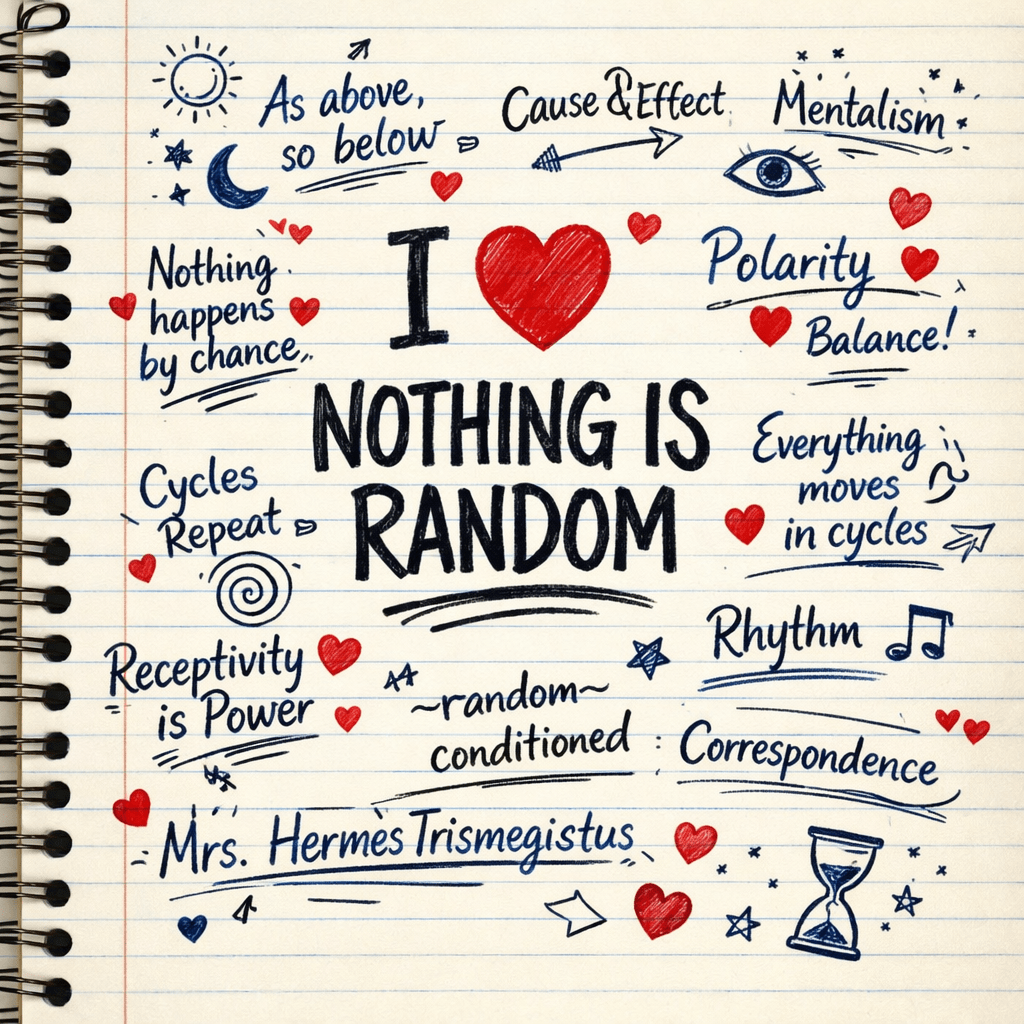
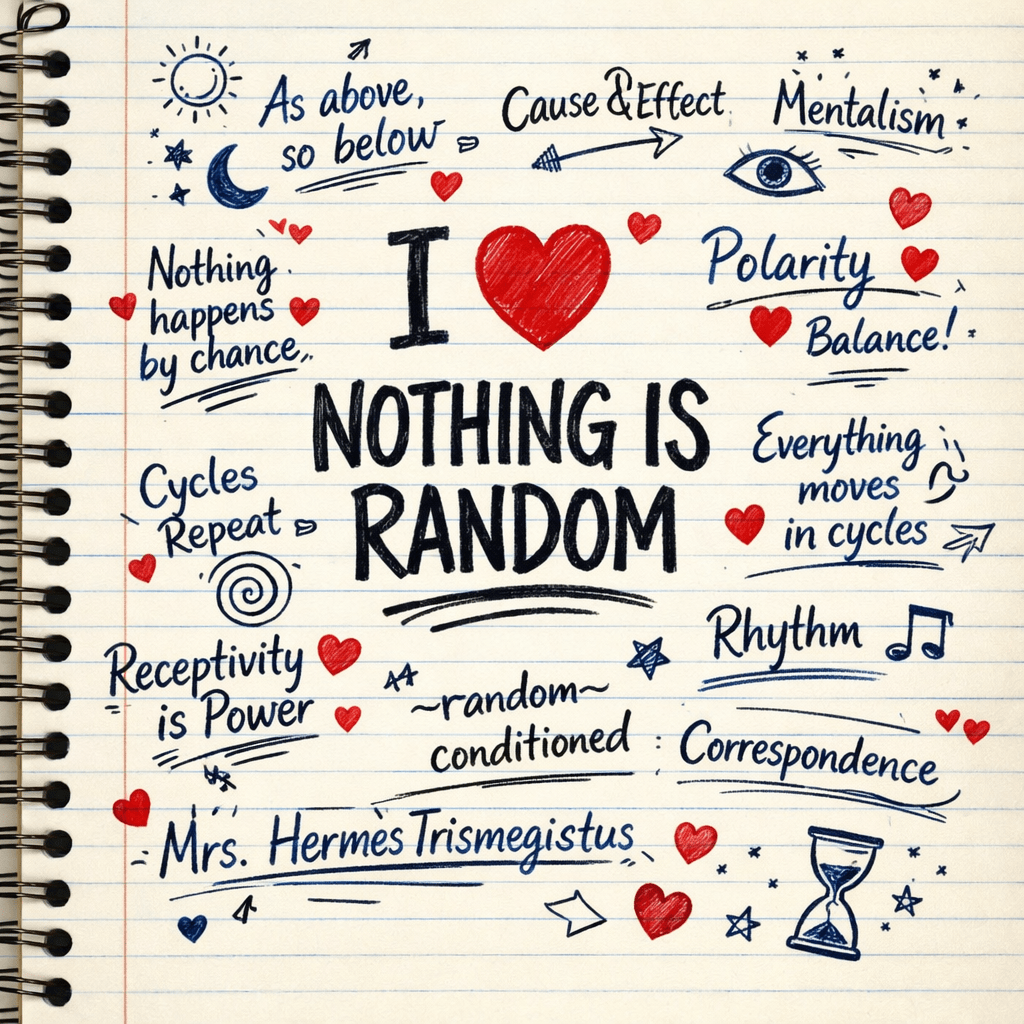
Guys. I’m Madly in Love. 🖤
(With a 2,000-Year-Old Philosophy)
©️2026 Shelly Moore
•••
With Valentine’s Day approaching, it feels like the right time to admit… I have always been significantly better at falling in love with ideas than with actual human beings.
Give me a book, a philosophy, a mind-expanding framework that rearranges how I see reality, and I’m all in. 🖤
Hearts in my eyes.
Devotion.
Obsession.
The whole nine yards and then some.
But put me in front of a real, emotionally complex, occasionally confusing human romantic relationship?
*tugs uncomfortably at collar*
So when I say I’ve fallen madly in love with a 2,000-year-old philosophy, this probably shouldn’t surprise anyone—least of all me.
Hermeticism didn’t sweep me off my feet with grand promises or dramatic revelations.
It didn’t tell me what to believe, who to worship, or how to fix my life in ten easy steps.
(I would have sprinted full speed in the opposite direction.)
It did something far more dangerous: it made sense.
The kind of sense that sneaks up on you, rearranges the furniture in your mind, and leaves you staring at the world thinking, oh… so that’s what’s been going on…
There’s a certain kind of recognition that doesn’t feel like learning something new—it feels like remembering something you’ve always known but never had language for.
That’s what happened to me when I started learning/reading about Hermeticism years ago.
Not in a dramatic, lightning-bolt, “I’ve found the truth” way.
More like a quiet internal click.
A settling.
A sense of oh… this is how I already see things. Fascinating.
•
First and foremost, Hermeticism isn’t a religion.
It’s not a belief system at all.
It doesn’t ask you to worship anything, convert anyone, or abandon science in favor of mysticism.
It’s more like a lens—a way of observing how reality behaves when you stop moralizing it and start paying attention.
An example that stopped me in my tracks was a simple image: a dust particle floating in a beam of sunlight.
That itty bitty speck isn’t random.
Not even a little bit.
It exists because of an almost incomprehensible chain of causes—stars that lived and died long before us, geological processes, erosion, air currents, a window opened at just the right moment, light hitting matter at the right angle, and my eyes being there in that specific moment to notice it.
Nothing mystical.
Nothing sentimental.
The same idea extends all the way down to the ittiest-bittiest of things.
Every single little hair on your little head.
The color nail polish you’re wearing.
The cute little white patch of fur on your dog’s chest.
The way that jackass pulled out in front of your car this morning and nearly killed you.
Not because it’s “meant to be,” but because nothing escapes causation.
Everything arises from conditions.
Everything is connected to what came before it.
And somehow, instead of making life feel cold or mechanical, that realization made it feel… astonishing.
What I love most about Hermetic thinking is that it replaces blame with pattern recognition.
And as an autistic woman—I’m a pattern seeking fanatic by my very nature.
So, instead of asking “who’s at fault?” it asks “what conditions produced this?”
Instead of dividing the world into good and evil, right and wrong, it notices polarity—how things exist on spectrums rather than in absolutes.
Love and hate aren’t opposites at war; they’re different intensities/varying degrees of the same damn thing.
• Heat and cold
• Light and dark
• Rest and motion
… all bookends of a spectrum.
Think about the concept of warm versus cold, for example.
Let’s say it’s 50° F (10° C) outside.
Well, if it’s mid-summer you’d say that’s a bit chilly. 🥶
If it’s mid-winter, you’d say that’s tee-shirt-no-coat warm. 🌴
The location of “warm” and “cold” on the spectrum of “temperature” is what gives them their definition.
Interesting, right?
And this doesn’t just apply to the external world.
It applies to us.
• Melancholy/Hopeful
• Apathetic/Motivated
• Anxious/Calm
• Distracted/Focused
• Grief/Gratitude
Not separate emotions.
Not moral failures or personality flaws.
Just different points along the same internal spectrum.
That realization alone quietly changed the way I look at my own inner world.
When I’m desperately low, unmotivated, or heavy… I’m not broken.
I’m simply parked at one end of the dial.
And dials, my friend… can be turned.
•
Another idea that resonated deeply for me is the Hermetic understanding of “gender.”
Not gender as identity or anatomy, but as principle.
Directionality.
Relationship.
The difference between projecting and receiving, initiating and containing, acting and holding.
This has absolutely nothing to do with what anyone has in their pants.
(This is the concept that usually derails people.)
Hermetic gender is symbolic + functional. Relational.
There are no penises nor vaginas involved.
If that sentence offends you — you’re still thinking too literally. Also, we’re all adults here. I hope.
Digest this:
🌱 Soil receives the seed.
🌊 The ocean receives the wave.
⭐️ The night sky holds the stars.
And my personal favorite…
🌎 The earth receives gravity.
Ah. Ever-elusive gravity. The one damn thing human science just cannot seem to nail down — relationally explained so beautifully by Hermetic principle.
• Our beautiful earth (Gaia/“feminine” energy) receiving gravity (“masculine” energy).
A symbiotic relationship where one holds the other.
•
Hermeticism also treats cycles with respect.
It doesn’t pathologize ebb and flow (it doesn’t see someone’s ups and downs as a problem).
It doesn’t pretend growth is linear or that decline means failure.
Everything moves in rhythms—rise and fall, expansion and contraction.
You can’t escape those tides.
You strap on a badass helmet and learn how to ride them.
•
What strikes me most is how practical all of this is.
Hermeticism isn’t trying to save you.
It’s trying to make you more perceptive.
More oriented.
More capable of understanding how small inputs compound, how environments shape outcomes, and how awareness changes leverage.
Which is speaking my language.
It doesn’t promise comfort.
It offers competence.
And maybe that’s why it’s never been loud, or mass-marketed, or especially popular… like religious texts.
It doesn’t tell you what to believe.
It doesn’t give you an enemy to fight or a savior to wait for.
It simply says… Listen, this is how things tend to work—pay attention.
For me, that way of seeing feels grounding AF.
It makes the world feel almost understandable.
It replaces panic with curiosity,
judgment with orientation,
and helplessness with participation.
•
I’m not sharing this because I think everyone should adopt Hermeticism.
I’m not a door-to-door salesman trying to push beliefs on you.
(I’m a terrible salesman, anyway.)
But if you’ve ever felt like you see patterns where others see chaos, relationships where others see randomness, or systems where others see isolated events—this lens might feel like a cashmere blanket to you, too.
Take what’s useful.
Leave the rest.
That’s all true wisdom is meant to do.
•
So, I did something different here because I was genuinely curious.
I don’t often consult AI. My brain is plenty full as it is. And I know people have divisive opinions on it. So, I tend to steer clear — especially for anything I put my name on.
I value integrity over all else.
But… I was curious today after I wrote the blog above.
So, I asked AI, “If you had to give me the five most important takeaways/lessons of Hermeticism, what would they be?”
👉🏻 Here was AI’s response:
If I had to distill Hermeticism down to five core takeaways that actually matter, it would be these:
1. Reality is lawful, not random
(Principle of Cause & Effect)
Hermeticism teaches that nothing “just happens.”
Not in a cruel way. Not in a blame-y way. In a mechanical way.
Every state, event, pattern, or outcome:
• arises from prior conditions
• follows laws, even if we don’t know them
• can be influenced by changing inputs
This is quietly empowering.
It means:
• chaos has structure
• confusion has causes
• suffering isn’t meaningless—even when it isn’t deserved
• you can intervene by altering conditions instead of fighting outcomes
This principle alone shifts you from victim of events to participant in systems.
2. Polarity explains conflict better than morality
(Principle of Polarity)
Hermeticism says opposites are not enemies—they are ends of the same continuum.
Heat and cold.
Love and hate.
Light and dark.
Strength and weakness.
This matters because it teaches you:
conflict doesn’t require villains people can occupy different ends of the same spectrum intensity can be transformed without destruction balance is dynamic, not static
It replaces judgment with orientation.
Instead of “who’s right?” you ask:
Where are we on the scale—and how could we move it?
That’s emotional maturity in philosophical form.
3. The inner and outer worlds are mirrors, not metaphors
(Principle of Correspondence — “As above, so below”)
This is not magical thinking. It’s systems thinking.
Hermeticism observes that:
• the same patterns repeat across scales
• inner states shape perception
• outer environments reinforce inner states
• structure echoes structure
This is why:
• chaos inside shows up as chaos outside
• clarity changes how reality responds to you
• containment creates order
• attention reorganizes experience
It doesn’t mean “think happy thoughts and reality obeys.”
It means:
Change the system, and the outputs change.
4. Receptivity is a form of power
(Principle of Gender, properly understood)
Hermeticism reframes power away from domination and toward relationship.
The “feminine” principle:
• holds
• receives
• gestates
• contextualizes
• gives form
The “masculine” principle:
• initiates
• projects
• moves
• differentiates
• executes
Creation happens between them.
This matters because it:
• restores dignity to depth, containment, and subconscious intelligence
• explains why presence can organize chaos
• validates inner worlds as functional, not indulgent
• shows why force without receptivity collapses
It’s one of the most quietly radical ideas in the teachings.
5. Mastery is internal before it is external
(Mentalism + Rhythm together)
Hermeticism does not promise control over the world.
It promises orientation within it.
It teaches that:
• the mind shapes experience
• rhythm governs cycles (rise/fall, expansion/contraction)
• resistance increases suffering
• awareness reduces impact
• you can step above a swing without stopping it
This is emotional sovereignty.
Not denial.
Not bypassing.
Skillful participation.
You don’t escape waves.
You learn to surf.
If I had to collapse all five into one sentence
Here it is:
Reality is patterned, relational, and lawful—and understanding those patterns gives you freedom without illusion.
That’s Hermeticism at its best.
No dogma.
No savior.
No shame.
No denial of being human.
Just:
• perception
• relationship
• responsibility
• quiet competence in the face of existence
And honestly? The fact that these don’t comfort everyone is exactly why they endure.
••
Then, I asked:
“What would you say are the most important things (I won’t put a number on it — tell me as may as you think of) humanity as a whole could take from Hermetic teachings modern day that could potentially change the world for the better?”
AI replied:
That’s a big, beautiful question—and I love that you didn’t cap the number. Hermeticism isn’t about “top 3 tips”; it’s about a posture toward reality. So I’ll name the takeaways that, if widely integrated (not believed, not preached—integrated), would genuinely change how humanity behaves.
Not utopian. Not fluffy. Practical shifts in perception.
1. Replace moral panic with pattern recognition
(Hermetic Cause & Effect)
If humanity absorbed just this:
Nothing arises without conditions.
We would:
• stop demonizing individuals for systemic outcomes
• stop pretending problems appear “out of nowhere”
• stop solving symptoms while reinforcing causes
Crime, addiction, climate collapse, burnout, political extremism—these aren’t moral failures first. They are predictable outputs of conditions.
Hermeticism trains people to ask:
“What inputs produced this, and which inputs can we change?”
That alone would move us from outrage to effective intervention.
2. Understand polarity instead of weaponizing difference
(Principle of Polarity)
Modern humanity treats difference as threat.
Hermeticism says:
Opposites are the same thing at different degrees.
If this were widely understood:
• disagreement wouldn’t require annihilation
• tension wouldn’t automatically mean hatred
• change wouldn’t require enemies
People could learn to:
• move along a spectrum instead of flipping sides
• modulate intensity instead of escalating conflict
• negotiate reality instead of absolutizing positions
This would radically de-escalate:
• culture wars
• ideological violence
• relational breakdown
Not by “being nicer,” but by understanding structure.
3. Stop outsourcing authority; develop perceptual literacy
(Mentalism, properly understood)
Hermeticism does not say “your thoughts create reality” in a naïve way.
It says:
Your mind shapes how reality is perceived, interpreted, and acted upon.
If humanity truly understood this:
• propaganda would lose much of its power
• fear-based manipulation would be easier to detect
• people would take responsibility for how information affects them
This would not make everyone “enlightened.”
It would make people less easily hijacked.
A perceptually literate population is very hard to control through panic.
4. Rehabilitate receptivity as strength
(Principle of Gender, correctly applied)
Modern culture glorifies:
• force
• speed
• dominance
• output
• control
Hermeticism reminds us that:
Nothing manifests without a receptive field.
If this were integrated:
• listening would be valued as much as speaking
• containment would be seen as power, not weakness
• depth would be respected, not mocked
• care, maintenance, and stewardship would regain dignity
This would change:
• how we treat the Earth
• how we value caregivers
• how we understand mental and emotional labor
• how leadership is defined
Not by flipping hierarchies—but by restoring balance.
5. Accept rhythm instead of pathologizing cycles
(Principle of Rhythm)
Modern society treats natural cycles as defects:
rest = laziness grief = disorder decline = failure pause = weakness
Hermeticism teaches:
Everything moves in tides. You don’t escape them—you learn to ride them.
If this were understood:
• burnout wouldn’t be treated as a personal flaw
• productivity wouldn’t be demanded at inhuman levels
• mental health wouldn’t be reduced to “fix it fast”
• economies might stop pretending infinite growth is possible
This would create more humane systems, not perfect ones.
6. Shift from salvation narratives to skillful participation
(This is a meta-principle)
Hermeticism offers:
• no savior
• no apocalypse reward
• no final victory
• no purity test
It offers competence.
If humanity internalized this:
• fewer people would wait to be rescued
• fewer would cling to catastrophic fantasies
• fewer would need villains to feel meaningful
People would focus on:
• improving conditions where they stand
• learning how systems work
• acting locally with awareness
That’s how real change happens—quietly, persistently, relationally.
7. Recognize that small causes compound
This may be the most transformative of all.
Hermeticism teaches that:
Tiny inputs matter because they accumulate.
If humanity truly believed this:
• people would stop dismissing “small” actions
• prevention would be valued over reaction
• maintenance would be respected
• long-term thinking would return
This applies to:
• climate
• health
• relationships
• education
• governance
Civilizations don’t collapse from one big mistake.
They collapse from ignored small ones.
Hermeticism trains attention where it actually matters.
If I had to say it in one paragraph
Here it is:
Hermeticism could change the world by teaching humanity to see reality as lawful, relational, cyclical, and participatory—replacing blame with understanding, force with balance, panic with perception, and passivity with skill.
No ideology.
No dogma.
No mass conversion.
Just better seeing.
And the quiet truth?
World change has always begun that way—long before it ever looked like a movement.
••
📚 Recommended Resources:
Hi, it’s me again. Not AI. The flawed human author with unruly hair and overwhelming emotions (also a terrible head cold at the moment 🤧).
If you’re interested in learning more about Hermeticism… I definitely have loads of resources for you.
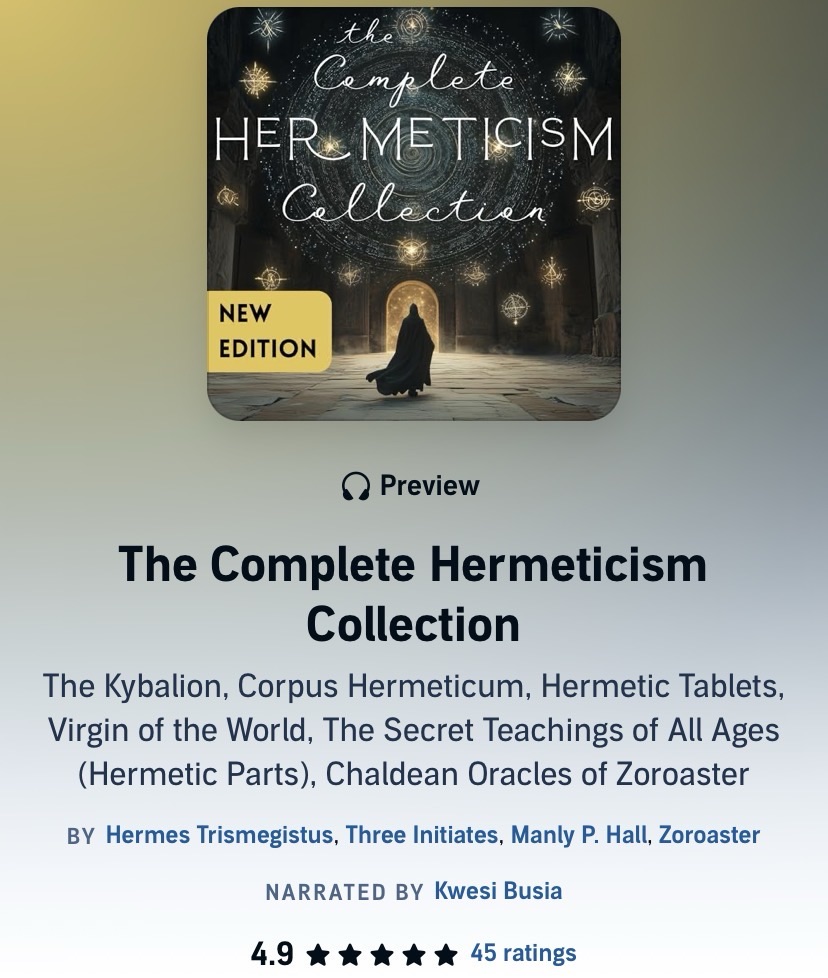
⬆️ Audible audiobook I’ve listened to twice through. It reads like a textbook, not a thriller… so don’t go into it thinking it’ll provide adrenaline. But it is utterly fascinating. The most complete collection of texts I’ve found to date. And — you can listen in your car on your drive to work.
 limitlessstimulus.com
Leave a comment