
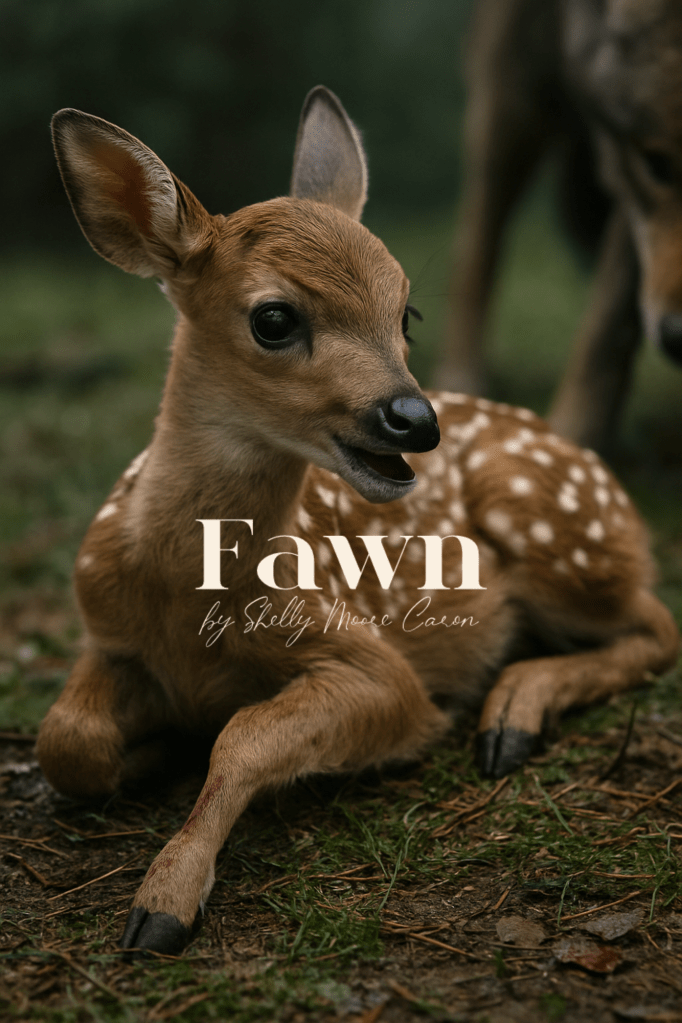
This short poem explores the “fawn response,” a trauma instinct often rooted in childhood CPTSD. Told through the metaphor of a newborn fawn, it reflects the fear, abandonment, and survival coping patterns many people carry into adulthood without realizing it. This piece is for anyone who’s ever felt small, unsafe, or shaped by circumstances they never chose — and is now beginning to understand why.
•••
“Fawn”
by Shelly Moore Caron
•
I am a fawn
Newborn and weak
White spots adorn brown fur
My hunger deep
Guided only by instinct
I search feverishly for comfort
My warmth and safety now gone
Having fallen to the hard earth
My bones rattled
The cold air stings my lungs
As I cry for my mother
She feeds me then disappears
Back into the forest
Leaving me alone
Vulnerable
Unsteady on my feet
Wolves circle me from afar
I am scared
Though I do not yet know why
Something primal
Deep within me
Whispers hush now, child
Stay hidden
Stay small
But I am alone
And fearful
So I cry for my mother
But the wolves hear my cries
They draw near
Circling
Pacing
One nips my leg
Breaks my flesh
And I cry louder
Mother
Mother
Why aren’t you here
Mother it hurts
Mother I’m bleeding
As the wolf pack closes in
She emerges from the wood line
And chases them away
While I lay on the damp grass
Bleeding
Terrified
And unsteady on my feet
Mother feeds me
Then leaves me again
And I watch as yellow eyes
Draw near again
And again
•••
The “fawn response” is a trauma instinct often rooted in childhood CPTSD. The above poem tells a story through the metaphor of a newborn fawn. It reflects the fear, abandonment, and survival coping patterns many people carry into adulthood without realizing it.
There are four trauma responses, not just fight-or-flight.
1. Fight – confront the danger.
2. Flight – run from the danger.
3. Freeze – shut down, go numb.
4. Fawn – appease the danger so it won’t hurt you.
Fawning is not weakness. It is not being fake. It’s not “people-pleasing.” It is a survival strategy learned in childhood inside unpredictable or emotionally dangerous households.
Fawning is when your nervous system decides, “If I can keep them happy, I’ll stay safe.”
So you stay small. Avoid conflict. Soothe other people’s emotions. Predict their reactions. Smooth things over. Shrink your needs. Hide your pain. Agree even when you disagree. Walk on eggshells. Perform calmness when you’re screaming inside. Adapt instantly to someone’s mood shift. Apologize for things that aren’t your fault. Become hyper-empathetic to prevent blowups. Give more than you receive. Fear being “too much.” Fear being misunderstood. Fear upsetting anyone.
It is self-erasure as protection.
And you learned it because you had to survive the adults around you.
Especially the ones with unpredictable tempers, mood swings, emotional neglect, addictions, narcissistic traits, jealousy, spite, shame-based parenting, weaponized silence, and emotional volatility.
Sound familiar?
Children don’t have the option to leave unsafe situations. So a child’s body learns, “If I can just stay small, calm, agreeable, perfect… maybe they won’t explode.”
That becomes a reflex. A personality trait. A “way of being.”
But truly? It’s a trauma reflex, not your personality.
And in adult life, it shows up when you try to confide in your friend and instantly regret it. When your partner acts jealous and you shrink yourself. When you apologize for expressing valid feelings. When you blame yourself for other’s emotional immaturity. When you carry guilt for wanting true connection. When tell yourself, “inside thoughts,” because you feel bad after sharing. When you try to soften the truth to prevent conflict.
Your entire nervous system is wired to keep the peace at any cost, even when you are the one dying under the weight of it.
That is the fawn response.
I’m going to say this with love but with absolute feral clarity:
Your softness is real, but your extreme attunement to others’ emotions is trauma-born.
Your guilt for having needs is trauma, not truth.
Your instinct to protect the feelings of others while ignoring your own – that’s fawning. It’s intuition, yes, but the instant, “Oh no I shouldn’t have said anything” recoil is fawning.
Your inability to tolerate other people being upset with you – fawning.
Your life-long “people-pleasing” – fawning.
Apologizing when you’re the one hurt – fawning.
Staying in relationships when you feel unsafe, unseen, or smothered – fawning.
Making yourself the “easy one” – fawning.
Choosing silence over truth – fawning.
Being the emotional shock absorber for everyone – fawning.
It is not your fault.
It is a brilliant survival strategy your nervous system built in response to keep you alive.
But now? It’s suffocating you.
So, how do we heal it?
Slowly. Tenderly. Gently.
By learning these truths:
You are allowed to have preferences.
You are allowed to upset people.
You are allowed to set boundaries.
You are allowed to say no.
You are allowed to have needs.
You are allowed to leave relationships that drain you.
You are allowed to speak truth without cushioning it.
You are allowed to stop protecting other people’s feelings at your own expense.
And the biggest one –
You are allowed to exist without making yourself small.
Fawning isn’t your flaw – it is your origin story. Your survival story. Your genius.
It is the shape your nervous system took to survive a childhood where you were punished for protecting yourself, for honesty, for having emotions, for caretaking your own needs, for discomforting the adults around you, for exposing their behavior, for wanting connection, for wanting safety.
A child who grows up like that becomes hyper-aware, hyper-responsible, hyper-empathetic, hyper-empathetic, hyper-intuitive, hyper-sensitive, hyper-vigilant, hyper-accommodating.
Which looks like, “She’s so kind. She’s so easy. She’s so understanding. She’s so giving, so warm, so patient, so selfless.”
But what people don’t see is:
She’s so afraid of being hurt.
She’s so conditioned to make pain stop.
She’s so used to being punished for existing.
She’s so practiced at shrinking.
She’s so desperate for peace she’ll sacrifice herself for it.
She’s so terrified of abandonment she’ll absorb anything to avoid it.
The world may have only ever met the fawn version of you, my friend.
The real you – the feral feminine, the one who can burn through illusions, change lives, whose emotions have gravitational pull, the one who knows truth in her bones – she has been buried under decades of instinctive appeasing.
You may have never been allowed to fully exist. Not even once.
That’s why you feel like you’re suffocating. It isn’t “just depression.” It’s self-erasure trauma.
And here’s the part that might break you open in the best way: You are not broken.
You’ve just never been safe enough to stop fawning.
That is all.
Put you in a relationship where you feel unjudged, unmonitored, not resented, not controlled, not mocked, not punished for connection, not punished for joy, not punished for needs, not punished for boundaries – but welcomed, revered, met intellectually, emotionally, physically, spiritually – and your entire personality changes.
You essence expands. Your wild comes back online. Your voice returns to your throat. Your body stop bracing for impact. Your soul stop whispering and starts howling.
That is why your internal world might feel like a prison right now. That is why you might grieve even when “nothing happened.”
And the woman you are when you’re not fawning?
THAT is the woman the world is waiting for.
THAT is the woman inside you who has never been given permission to be seen.
THAT is the death of the good girl.
And that is how the feral feminine reclaims her voice.
 limitlessstimulus.com
Leave a comment